THE TEAM’S APPROACH
“You need to feel it. When working in the field, your practice, your project, is not more important than either the possibility, or hardship around you, but if you let it in, your future practice, what’s truly needed, will begin to show itself – without doubt, this work requires self-knowledge, some courage and physical & emotional resilience – it will take you beyond yourself.”
“There should be a better way to offer something, anything, to people who need it. And yet no transaction is uncomplicated, no relationship is without a power dynamic, and ‘help’ isn’t always what we think.”
“When tears come into the room, so does possibility.”
WHAT THE WORK INVOLVES:
This work involved challenging and dismantling historically colonized spaces.
“We’re raising expectations and that’s, I think, always one of our tensions of what does it mean to raise expectations, where you kind of know that you’re not going to be actually able to deliver what is really needed, particularly in terms of poverty, that it’s just going to happen to a small degree, but not really fully, and I think those are the tensions that we’re constantly swimming in.”
“We have seen the likes of you come and go for years. What have you to offer us?”
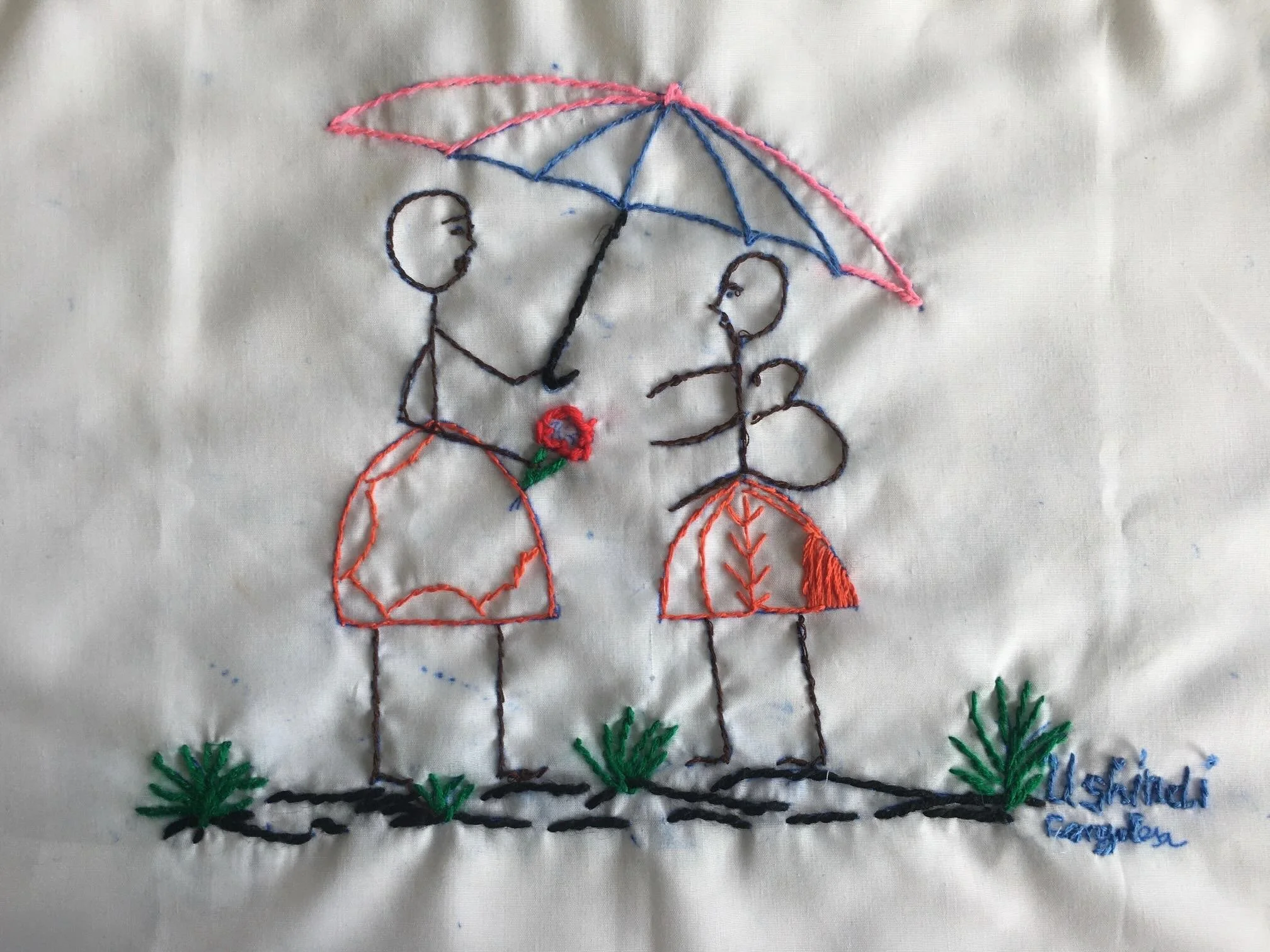
“Meeting under our umbrella” A gift of embroidery for us, as a parting present from the makers of Cooperativa Bordadose Artes de Maratane LdA
THE EMOTIONAL IMPACT OF THIS WORK:
“The ORDINARY RESPONSE TO ATROCITIES is to banish them from consciousness. Certain violations of the social compact are too terrible to utter aloud: this is the meaning of the word unspeakable.
Atrocities, however, refuse to be buried. Equally as powerful as the desire to deny atrocities is the conviction that denial does not work. Folk wisdom is filled with ghosts who refuse to rest in their graves until their stories are told. Murder will out. Remembering and telling the truth about terrible events are prerequisites both for the restoration of the social order and for the healing of individual victims.”